
Chatbot versus AI chat: what is the difference?
What is the difference between a chatbot and an AI receptionist?
Chatbots have been growing in popularity for years. Many businesses use them to help customers faster. These days, however, you increasingly hear the term AI assistant or AI receptionist. What is the difference between a traditional chatbot and an AI receptionist? And more importantly, which is the best fit for your organisation?
In this article, we explain it clearly so that, as a business owner or marketer, you can make an informed choice.
What is a traditional chatbot?
A traditional chatbot works with preset rules or scripts. You (or your supplier) enter questions and answers and link keywords or buttons to them. As soon as a user types something matching one of those keywords, a fixed answer or a selection menu follows.
Characteristics of a traditional chatbot:
- Works with if-then logic (if-this-then-that)
- Limited to preprogrammed scenarios
- Struggles with free-form input or unexpected questions
- Often feels somewhat stilted or limited
- Limited usefulness in complex environments
This can work well for simple customer questions such as “What are the opening hours?”. But as soon as the user departs from the script, confusion and frustration soon follow.
What is an AI assistant or AI receptionist?
An AI assistant is based on artificial intelligence and natural language processing (NLP). This means the assistant recognises words and also understands the intent behind the question. It then builds an answer dynamically using the available information.
Characteristics of an AI receptionist:
- Understands natural language, including spelling mistakes or variations
- Learns from previous conversations and context
- Connects to external data sources in real time, such as a booking system, documents or a website
- Provides unique, personalised answers
- Works consistently and hospitably 24/7
An AI assistant is therefore much more flexible and intelligent. It is ideal if you work in an environment with a wide variety of questions and guests, such as the leisure industry.
A practical example
Scenario: a guest asks through WhatsApp: “Is there still a chalet available for 4 people next weekend, with a dog?”
- Traditional chatbot: recognises only ‘chalet’ or ‘dog’ and sends a standard link to the chalet page or the page about dogs. In the worst case, the chatbot is already confused because several questions have been combined into 1.
- AI receptionist: understands the intent, checks availability, knows whether dogs are allowed and immediately sends a personalised answer with a booking link.
The result: faster service, higher conversion and a much better guest experience.
Why switch to AI?
Guests’ expectations have changed. They want:
- An immediate answer, even in the evening or at weekends
- A real conversation rather than a selection menu
- Accurate answers, even to complicated questions
An AI receptionist is scalable, error-free and always friendly. For organisations, that means:
- Fewer phone calls and emails
- Greater guest satisfaction
- More bookings with less manual work
Is AI always better than a chatbot?
Not necessarily. For very simple applications with a limited number of questions, a traditional chatbot can be sufficient. Think of a selection menu for opening hours or an FAQ page.
But as soon as you receive more than 10 frequently asked questions, work with changing availability or products, or handle customer contact through several channels (website, WhatsApp, email) AI is often the better choice.
At a glance: the main differences
| Feature | Traditional chatbot | AI receptionist (such as Holli) |
| How it works | Rule-based (scripts) | AI/NLP, understands intent |
| Flexibility | Limited | High |
| Scalability | Limited | Unlimited |
| Tailored answers | Standard answers only | Personal and dynamic |
| Learning from conversations | No | Yes |
| Suitable for complex questions | No | Yes |
| Suitable for the leisure industry | Limited | Yes (with industry knowledge) |
Holli: the AI receptionist for the leisure industry
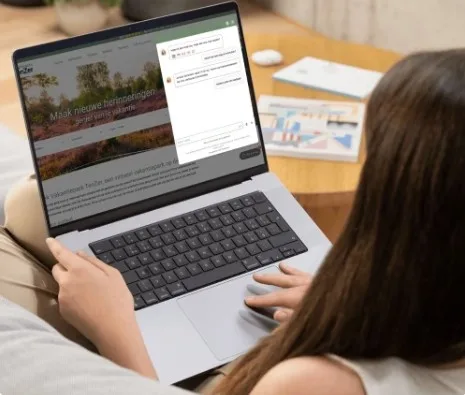
Holli was developed for campsites, holiday parks and group accommodation. With industry-specific knowledge, smart integrations and natural conversation, Holli feels like a valuable addition to your team. Holli can easily be connected to various reservation software packages, such as Booking Experts or CampingCare, allowing visitors to your website or your own app to request prices and availability directly. And if accommodation is occupied, she offers alternatives, just as a receptionist would.
Other benefits? Live within one day. Easy to manage. And always in your tone of voice. Your staff can focus on real hospitality. Smart, efficient and always available!